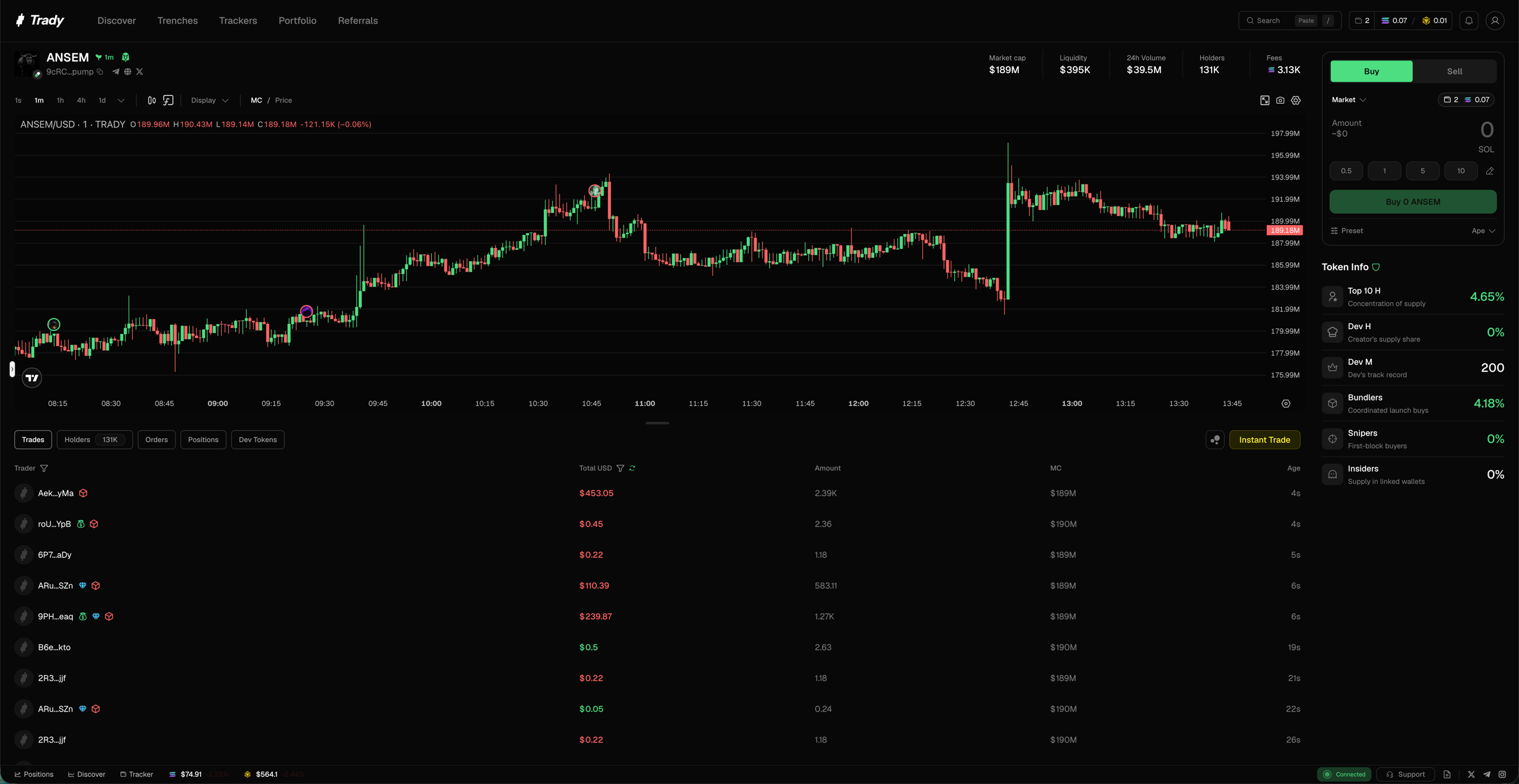
Everything you would otherwise open five tools to check, sitting on one screen next to the buy button. The goal is simple — no tab-switching to vet a coin.
Hero bar
The vital signs across the top:
- Pair info — token, ticker, chain, pool
- Market cap and price — with 24h change
- Volume — is anyone actually here?
- Liquidity — can you get out at size?
- Holders — how many, growing or bleeding
- Fees — fee flow from the token’s trading. Real volume produces proportional fees; a huge “volume” number with pocket-change fees is a painted chart
Token info
The vet-before-you-ape block:
- Top 10 holders % — share held by the top 10 wallets
- Dev holding % — how much the creator kept
- Bundlers % — supply sitting in coordinated wallets
- Snipers % — supply grabbed in the first blocks
- Insiders % — wallets linked to the deployer
Red flags are highlighted. What each threshold means and when to walk away: Reading a Token Page.
Chart
Full candlestick chart with drawing tools and indicators. Limit orders you place appear as lines on the chart.
Trade panel
Buy/sell without leaving the page — market, limit (TP/SL), or instant, with your transaction settings one click away.
Bottom tabs
The 30-second vet
Before any entry: (1) hero bar — liquidity real, fees proportional to volume; (2) Token info — top 10 ex-LP sane, dev holding modest, bundlers under ~15%, snipers not stacked; (3) Dev tokens — serial rugger or first-timer; (4) Trades — organic two-way flow, not bot staircase. Ten seconds each. The full checklist with thresholds: Rug-Check Basics.
Frequently asked questions
If a token’s metrics look clean, is it safe to buy?
Clean numbers mean the checkable things check out. They can’t see intentions: a clean contract with hidden coordinated supply is still a controlled dump waiting to happen. Numbers + dev history + the tape together, always.
Why does the top holder show a huge %?
Check whether it’s the LP/pool address — interfaces list it among holders, but it’s not a trader. Last modified on August 18, 2026